
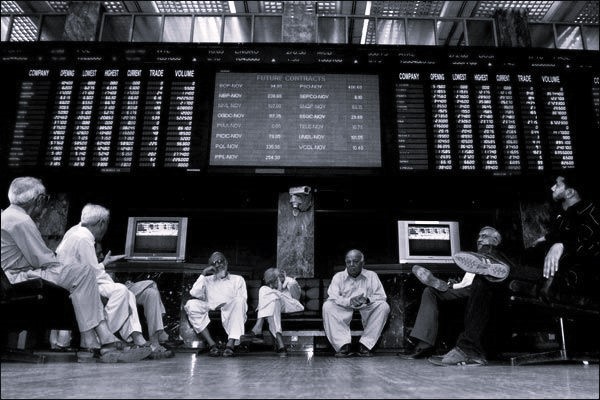
The KSE-100 index recently hit an all-time high of 170,719 points. In PKR terms, the index has delivered extraordinary returns for investors who held through Pakistan’s 2023 crisis period. The question now is whether the index is still a value play — or whether the easy money has been made.
Where the P/E sits
The KSE-100 currently trades at a price-to-earnings (P/E) ratio of approximately 9.2x. That is above the three-year historical average of 6.9x but still low by any emerging market standard. The MSCI Emerging Markets index typically trades at 12–14x. Indian equities (Nifty 50) trade above 20x. In absolute terms, the KSE-100 is inexpensive.
Earnings for listed Pakistani companies have grown roughly 12% per year over the past three years, while revenues grew 5% per year. The gap between earnings growth and revenue growth reflects margin expansion — in part from declining interest costs as the SBP cut rates from a 22% peak, and in part from PKR stabilisation reducing import costs for manufacturers.
The earnings yield vs. the risk-free rate
A P/E of 9.2x implies an earnings yield of roughly 10.9% (1 ÷ 9.2). The SBP’s current policy rate is 11.5%, following the April 2026 hike. This is a meaningful comparison: when the risk-free rate exceeds the earnings yield, equities are offering less compensation per unit of risk than government paper. The spread has compressed significantly from early 2025, when rates were being cut and the earnings yield comfortably exceeded government bond yields.
What the “cheap” label hides
Low P/E ratios in frontier markets are rarely free money. Pakistan’s discount relative to peers reflects genuine structural risks.
Currency risk. The PKR has depreciated materially over the long run. Dollar-adjusted returns have been substantially lower than PKR returns. A foreign investor holding KSE-100 stocks in dollar terms has a very different experience from a domestic investor.
Political and policy risk. Pakistan’s macroeconomic policy has reversed sharply multiple times — exchange rate controls lifted, subsidy regimes changed, import restrictions imposed and removed. Earnings projections carry unusually wide confidence intervals.
Governance and liquidity. Market capitalisation as a share of GDP remains low. Many listed companies have concentrated ownership, limiting free float. Institutional depth is limited compared to peer markets.
The sectors doing the heavy lifting
Banking, oil and gas, and fertilisers dominate KSE-100 weighting and earnings. Banks benefited from the high-rate environment of 2022–2024 through net interest margin expansion. That tailwind is fading as rates decline. Oil and gas producers are exposed to government-controlled energy pricing. Fertilisers benefit from agricultural demand that is seasonally volatile.
The index’s historical cheapness has often been a reflection of these sector concentrations rather than broad market opportunity across all industries.
Bottom line
At 9.2x P/E, the KSE-100 is not obviously overvalued — but it is no longer the extreme value it was at 6.9x. The margin of safety has narrowed. The thesis now requires earnings to grow into current prices rather than multiple expansion doing the work. Investors willing to take on currency and political risk for an earnings yield approaching 11% will find it competitive against USD-denominated alternatives. Those relying purely on cheapness to carry the investment need a harder look at the underlying earnings quality.
Sources: SimplyWallSt Pakistan Market Valuations; pkfinance.info KSE-100 Valuation Data; Trading Economics Pakistan Stock Market; SBP monetary policy statements.

 Bloom Capital Review
Leave a comment