
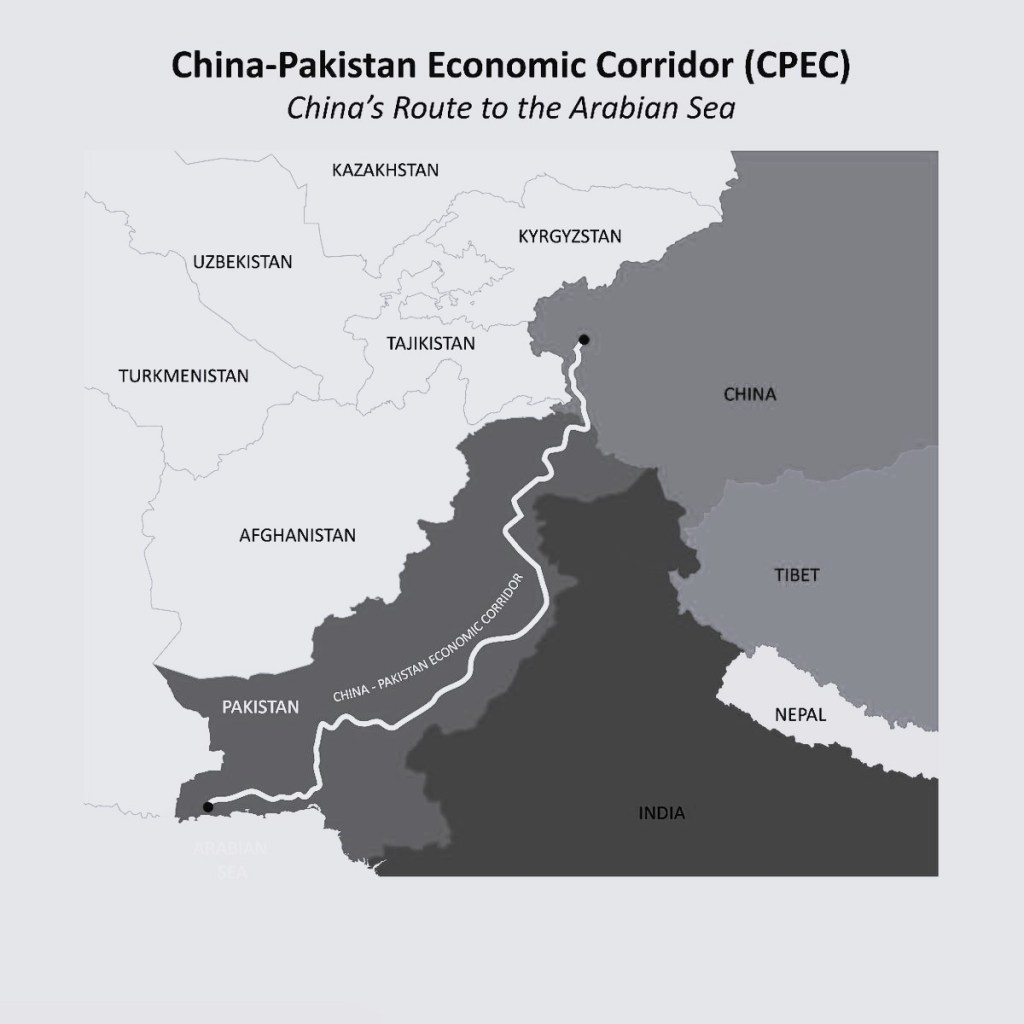
The China-Pakistan Economic Corridor has completed 43 projects worth $24.7 billion under its first phase, which focused heavily on power generation and road infrastructure. Phase Two, now fully underway, is a different kind of programme — less about megaprojects and more about industrialisation, supply chain integration, and converting completed infrastructure into productive economic activity.
Whether that transition delivers on its promise depends on factors that are harder to control than cement and steel.
What Phase One built — and what it cost
Phase One’s dominant legacy is power. More than two-thirds of CPEC Phase One investment went into electricity generation — coal, solar, wind, and hydro projects that added significant capacity to Pakistan’s grid. The infrastructure component added motorways, the Gwadar port, and early-stage Special Economic Zone construction.
The trade-off was debt. Phase One was financed predominantly through Chinese sovereign-backed loans, with debt service obligations denominated in foreign currency. The power purchase agreements underpinning CPEC power plants require capacity payments in dollars regardless of how much electricity is actually dispatched. These capacity payments have become a material strain on both Pakistan’s circular debt problem in the power sector and the country’s foreign exchange position — a cost that was not fully priced into the original project economics.
How Phase Two differs
The Industrial Cooperation Action Plan (2025–2029) is the framework document for Phase Two. It targets: chemicals and pharmaceuticals, agro-processing, engineering goods, iron and steel, and light manufacturing. The goal is to attract Chinese manufacturing investment into Pakistan’s Special Economic Zones — leveraging lower labour costs and preferential trade arrangements to integrate Pakistan into Chinese-anchored supply chains.
Nine SEZs were originally notified under CPEC Phase One. Under Phase Two, 44 SEZs are now formally designated — 37 newly notified zones through the Board of Investment. The expansion is ambitious. The challenge is that an SEZ is only as productive as the infrastructure, regulatory environment, and utility supply that surrounds it.
On the ground, Phase Two is showing early signs of momentum. China contributed $188.6 million in FDI in Q1 FY2026 (July–September 2025) alone, representing over one-third of Pakistan’s total FDI in that quarter. Memoranda of Understanding worth $8.5 billion were signed during business-to-business engagements in September 2025. Gwadar’s new international airport became operational in 2025, a significant connectivity milestone for the port city that sits at the heart of CPEC’s long-term strategic logic.
The balance of payments arithmetic
CPEC’s net impact on Pakistan’s current account is more nuanced than the headline investment figures suggest.
On the inflow side: FDI from Chinese investors brings in foreign currency. Fresh loan disbursements provide budget and balance-of-payments support. Completed infrastructure — once operational — creates productive capacity without requiring ongoing foreign exchange spending.
On the outflow side: Phase One power plants remit profits and dividends to Chinese equity holders in foreign currency. Debt service on CPEC loans runs at an estimated $1.5–2 billion per year. Equipment and machinery for new Phase Two projects is largely sourced from China, creating import demand rather than domestic supply chain development. And historically, a large share of CPEC construction contracts employed Chinese labour and Chinese inputs, limiting the domestic multiplier effect.
The Finance Ministry reported a significant 79% reduction in the current account deficit over two months in FY2026 — but this improvement was driven more by robust remittances and stable exports than by CPEC-linked FDI materialising at scale. The gap between announced MoU values and actual FDI realisation remains the most important tracking metric for Phase Two.
The structural question
Phase Two’s promise is industrial deepening — shifting Pakistan from an infrastructure recipient to a manufacturing participant in China’s supply chain diversification. The incentive for China is real: rising labour costs in coastal provinces and geopolitical pressure to diversify production locations make Pakistan’s 240 million people and strategic geography genuinely attractive.
But Pakistan’s manufacturing base has historically struggled with high energy costs, imported input costs that fluctuate with the PKR, and an inconsistent regulatory environment. Getting Chinese manufacturers to commit production to Pakistan requires solving the same problems that have constrained domestic manufacturers for decades. Phase Two makes that task more urgent. It does not make it easier.
Sources: CPEC Secretariat Progress Update; MP-IDSA Issue Brief on CPEC Phase II and China-Linked Supply Chains; Xinhua / Dawn on Q1 FY2026 Chinese FDI; Pakistan Finance Ministry current account data; Wikipedia, China–Pakistan Economic Corridor (project totals).

 Bloom Capital Review
Leave a comment